
What Can Businesses Do to Improve Their WELL Score?
As businesses place greater emphasis on employee wellbeing and ESG performance, the WELL Building Standard is becoming an increasingly important consideration across the built environment sector.
To explore the opportunities and challenges associated with delivering healthier workplaces, CPW has partnered with urban farming specialists Square Mile Farms to produce ‘Greener Workplaces’ – a white paper examining the WELL Building Standard v2, with a particular focus on the concepts of Mind and Nourishment.

Amy Thrupp, Associate Director of Sustainability at CPW, and co-author of ‘Greener Workplaces’
Authored by Associate Director of Sustainability at CPW, Amy Thrupp, and Chief Growth Officer & Director at Square Mile Farms, Hamish Grant, the paper provides an introduction to WELL and explores how design teams can create environments that positively influence end-user health and wellbeing.
Why Are More Organisations Looking at WELL?
Unlike traditional sustainability frameworks, which primarily focus on environmental performance, the WELL Building Standard places people at the heart of building design and operation.
The framework assesses how buildings support the wellbeing of occupants through ten core concepts:
Air
Water
Nourishment
Light
Movement
Thermal Comfort
Sound
Materials
Mind
Community
For businesses pursuing WELL certification, success often comes from taking a holistic approach. Strategies can range from improving indoor environmental quality and encouraging movement to supporting healthy eating, social engagement and mental wellbeing.
As companies continue to compete for talent and seek to improve the workplace experience, many are increasingly viewing wellbeing-focused design as a key part of successful business performance.
Creating Value Through Better Building Design
Developers, architects and consultants are increasingly being asked to demonstrate how buildings support occupant wellbeing, alongside environmental performance. By providing a recognised framework, WELL helps project teams translate wellbeing ambitions into measurable and achievable outcomes. In turn, this can help create spaces that improve user satisfaction, strengthen workplace culture and support broader ESG objectives.
As expectations around healthy buildings continue to evolve, understanding how wellbeing can be embedded within projects is becoming a growing area of focus across the industry. While the WELL framework encompasses ten concepts, CPW's latest white paper takes a closer look at two areas in particular that are gaining traction: Mind and Nourishment.
In a world where remote working is increasingly common, these themes are particularly relevant, as employers seek new ways to create engaging workplaces that encourage people back into the office.
Greener Workplaces explores how innovative initiatives, such as indoor urban farming, can contribute to these objectives while creating opportunities for education and social connection.
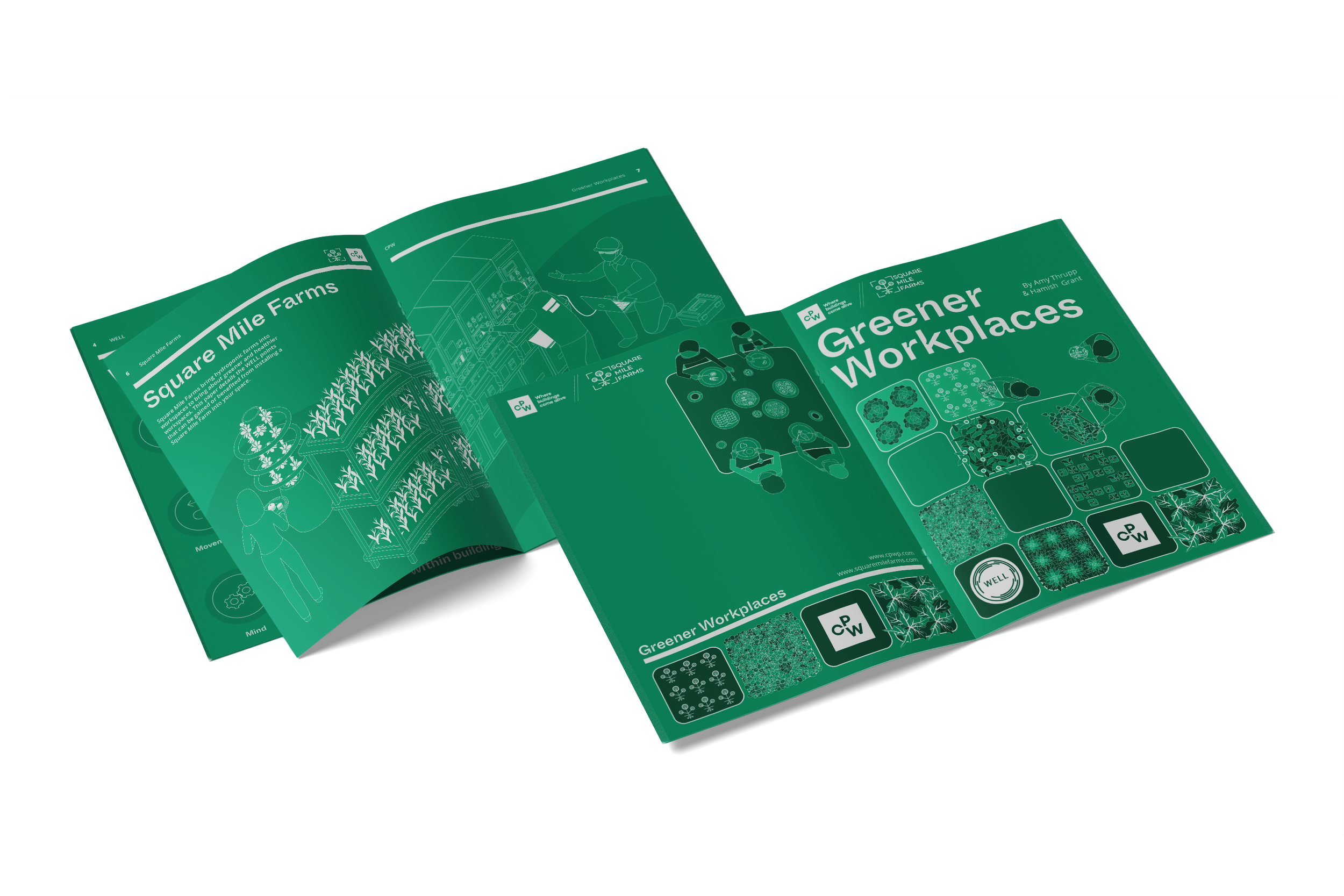
Download ‘Greener Workplaces’ by CPW x Square Mile Farms today and discover how the principles of WELL can help shape the future of workplace design.
Looking Ahead: The Introduction of One WELL
The publication also comes at a significant moment for the WELL Building Standard.
The International WELL Building Institute is currently preparing to launch One WELL, a new unified framework that will bring together WELL v2, WELL Ratings and residential pathways into a single system.
Expected to launch in late 2026, One WELL aims to simplify the certification process while maintaining the ten established WELL Concepts. The updated framework will introduce new themes, strategies and certification routes, helping project teams track progress more efficiently, and apply wellbeing principles across a wider range of asset types.
New designations will include:
Real Estate Portfolio
Real Estate Operations and Maintenance
WELL Interiors
The changes reflect the growing importance of health and wellbeing considerations across the property sector and are expected to provide greater flexibility for organisations looking to implement WELL at scale.
For further information on WELL Assessments and certification, get in touch with the Sustainability Team here.